The Ridings
H is for HawkThe Ridings is the countryside through which the book traces T. H. White’s life with Gos, and its significance lies in the way landscape becomes part of the relationship’s action rather than mere scenery. Woods, ponds, fields, and the designed grounds around Stowe offer the hawk successive points of view, while rain and wind alter what the human and bird can do. The place holds both a composed rural order and the limits of human control over an animal moving through it.
Landscape and setting
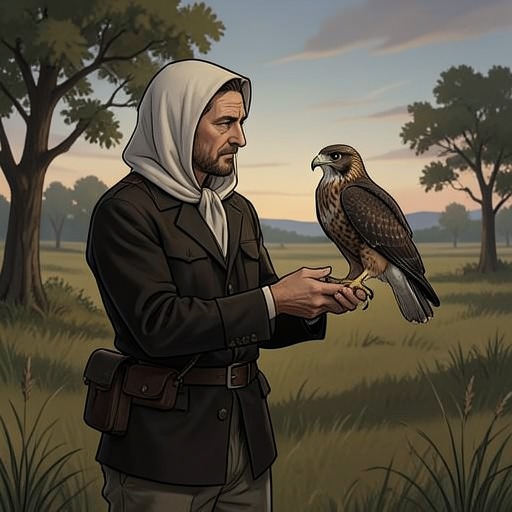
In a scene of White writing at night, the account imagines the leaves across The Ridings as still, extending the view over Three Parks Woods and Stowe Woods, across Sawpit Woods, and above the Black Pits ponds. The landscape is presented as a connected rural expanse rather than a single enclosed setting. White’s hawk is asleep while he writes, bringing domestic quiet into contact with the surrounding woods and water. The stillness belongs to a particular moment; elsewhere, the same countryside becomes difficult to cross or manage as weather changes.
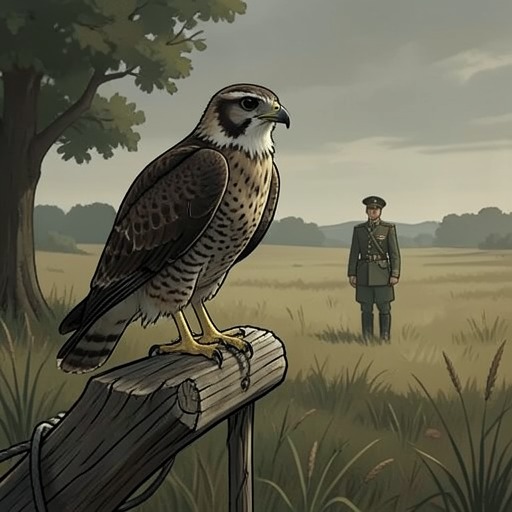
The place is also marked by the designed grounds around Stowe. From a high oak, Gos looks across fields towards Stowe, with the palace, lakes, obelisks, temples, and classical avenues visible in the distance. The arrangement of avenues and sightlines was laid out by people centuries earlier. From the hawk’s elevated position, that human design becomes part of the view, but not its controlling perspective: the landscape is also a field of movement and possible flight. The scene brings together a designed estate and a bird whose immediate advantage is height and an unobstructed outlook.
The hawk’s changing vantage
Gos’s ascent begins when he is left at a well while White briefly goes away. With no person at the end of his line, the hawk moves from the railing to a nearby tree and then climbs from branch to branch. The sequence changes the relation between bird and human: White’s customary place beside Gos is absent, while the hawk finds a route upward through the trees. At the top, the view over the Stowe landscape seems to open around him. The account gives the hawk a position from which the grounds appear less like a human composition than a world laid out for his sight.
The same trees later become a setting for difficulty. When Gos becomes entangled in a line among the branches, White cannot simply call him down; he has to work out how to reach and retrieve him. The episode makes the landscape more than a succession of scenic views. Branches, height, and the limits of access determine what White can do, while the hawk’s movements are not fully governed by the person handling the line. The episode also anticipates how easily an arrangement meant to keep the bird close can become a source of danger or uncertainty.
Weather, confinement, and loss
The Ridings is explicitly named again as storm clouds and heavy rain move over the countryside. Cattle shelter beneath trees, and White tries to give Gos more room to move by placing a bowperch outside the barn and connecting it to an indoor perch with six yards of twine. The line has already proved unreliable, but White believes the arrangement will let the hawk go outside and return. When Gos flies from the barn, White finds the perch empty and the line broken. The episode turns a local detail of equipment into a consequence: the attempt to balance movement with security does not keep the bird there.
In a later search, White looks for Gos across the rain-darkened landscape. He places pieces of rabbit at locations where the hawk had been and listens for signs that might disclose where he has gone. A crow circling a tree leads White to Gos, perched above the ground. White offers food and a handkerchief as a lure, but wind catches the hawk as he begins to descend and carries him away from the man. The landscape acts on the event: distance makes the bird small in view, the tree provides a temporary perch, and the gale defeats the planned return. The account does not turn the countryside into a remedy for loss; it shows how little a familiar place guarantees that a lost animal can be recovered.
Land, access, and the wider countryside
The book’s broader discussion of falconry gives this rural setting a social dimension. Goshawks can hunt by making a short dash after prey at close range, so they can be flown in many places. Properly flying falcons, by contrast, requires open ground such as grouse moors, partridge estates, and extensive farmland, landscapes more readily available to the wealthy or well connected. Historical praise of the noble falcon and contempt for the solitary goshawk trainer therefore reflect not only opinions about birds, but also differences in who could reach particular kinds of land and participate in particular forms of hunting.
A later comparison with Maine clarifies that access to hunting ground is not universal or inevitable. The account describes Maine’s common-law tradition of hunting over land and contrasts it with the exclusions associated with British estates and elite shooting grounds. Maine is not The Ridings, but the comparison places White’s countryside within a wider argument about land, class, and hunting. The Ridings consequently carries two kinds of order at once: the visible design of the Stowe grounds and the social arrangements that determine who can use the countryside. Against both, Gos’s movement remains only partly controllable, giving the landscape its recurring tension between human arrangement and animal independence.